
There is a familiar pattern in modern life. A problem appears in some essential public system. The problem is real. The victims are real. The frustration is real. Then, almost immediately, the proposed solution is not merely to punish the bad actor or repair the broken design, but to increase centralized control over everyone who uses the system.
The argument is always presented in the language of safety.
We need more control to stop fraud.
We need more identification to stop abuse.
We need more monitoring to stop danger.
We need more permissions to protect people.
Sometimes this is true. There are kinds of government action that clearly support a free and prosperous society. Clean water, sanitation, safe food, reliable bridges, honest weights and measures, and fire codes are not violations of human dignity. They are the ordinary bedrock of civilization. No sound-minded person chooses contaminated water over clean water for daily use. No one wants buildings that collapse, meat that poisons families, or electrical systems that turn homes into traps. These are baseline conditions. Government, at its best, helps maintain them.
But there is another species of control entirely.
This second species does not merely preserve a shared condition. It gates access to ordinary life. It says that before you may communicate, transact, travel, publish, work, or participate, you must become more visible, more legible, more registered, more permissioned. It takes an obvious good, such as reducing robocalls or fraud, and uses it to justify a much broader mechanism of control. The public is asked whether it wants fewer bad things, but the real question is whether the proposed tool creates a permanent chokepoint over everyday citizenship.
This distinction matters.
Clean water regulation improves the environment in which people live. Identity-gated communication changes the relationship between the person and the system. The first kind of rule says, “The shared infrastructure must be safe.” The second says, “You must be known before you may act.”
The first can support liberty.
The second can quietly hollow it out.
We are now reaching the point where this distinction will become one of the central political and technological questions of our time. Not because phones are the only issue, or because advertising is the only issue, or because artificial intelligence is the only issue. Rather, all these issues are beginning to converge around one theme: who controls access to the individual?
For most of modern history, our communication systems have been wonderfully simple in one sense. Here is an address. Dial it. Ring the other party. The telegraph, the telephone, email, and messaging all inherited this basic romance of interconnection. In a trusted ecosystem, that simplicity is beautiful. The network does not ask too many questions. It simply carries the message.
But time has shown that open channels are also abused. Scammers, spammers, foreign actors, domestic predators, manipulative institutions, political machines, and automated sales systems have all learned to exploit openness. Robocalls are not merely annoying. They are part of a larger pattern: hostile access to human attention.
The obvious temptation is to respond by turning the whole network into a checkpoint. Make everyone prove who they are. Make every channel identity-bound. Expand retention. Increase carrier obligations. Turn access into compliance.
But there is a better path.
Keep the network open, but make the edge intelligent.
The communication provider should maintain interconnection, reliability, authentication, anti-spoofing, abuse throttling, and flood control. That is the network equivalent of public sanitation and bridge maintenance. If call traffic behaves like a denial-of-service attack, carriers should have safeguards. If caller identity is being forged, protocols should be improved. If upstream providers knowingly route abusive traffic, there should be consequences.
But the individual should be empowered to control attention.
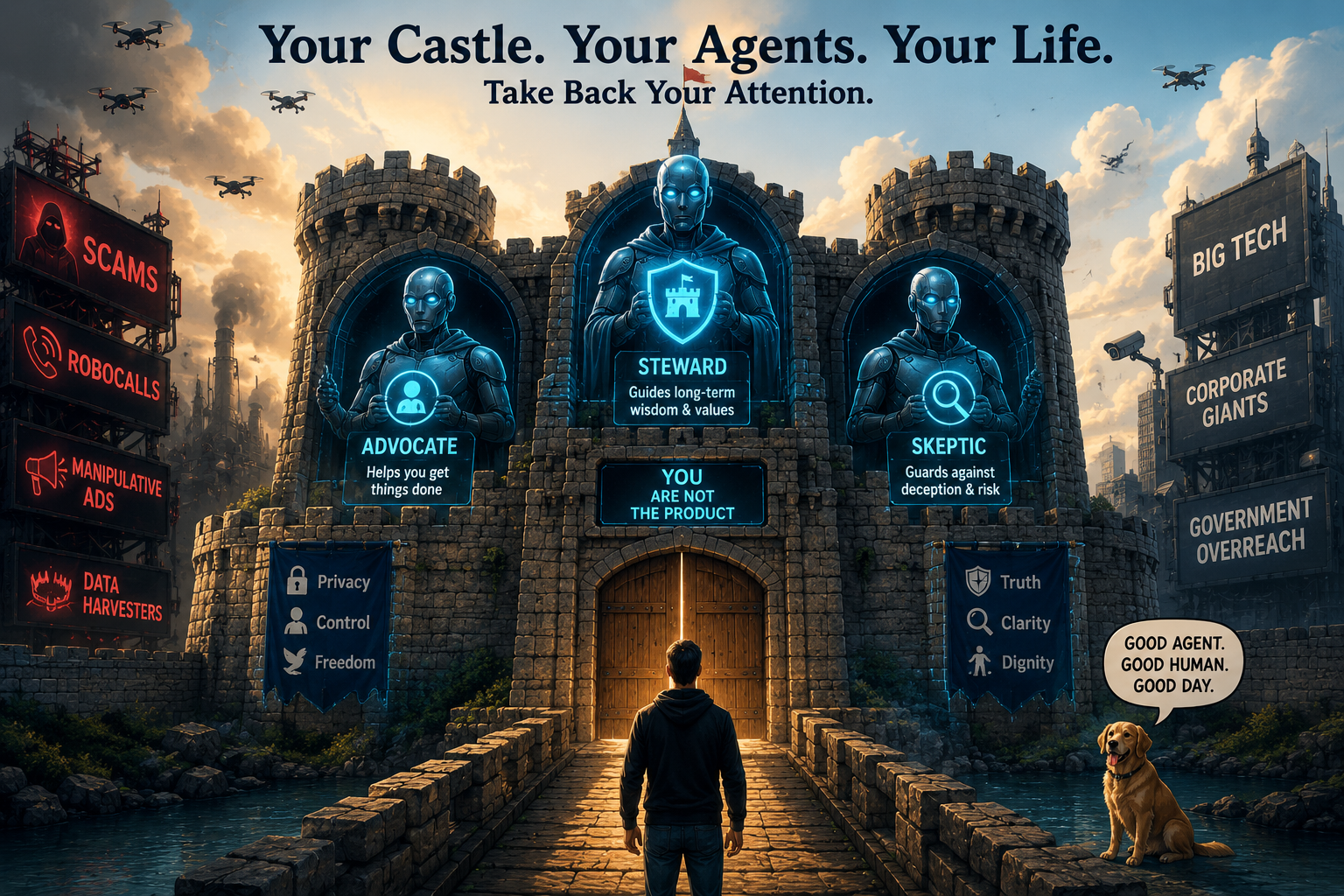
This is where personal AI agents could become one of the most important dignity-restoring technologies ever created. Not AI as a corporate surveillance layer. Not AI as a replacement worker hidden behind a customer-service script. Not AI as a manipulative advertising engine. But AI as a personal shield, owned and directed by the individual.
Imagine an agent that answers unknown calls before they reach you.
Who are you?
What organization do you represent?
What is the purpose of this call?
Can you verify your relationship to my user?
Can this be handled by text or email?
Can you provide a callback path through a known public channel?
Is this urgent, or merely phrased as urgent?
Most illegitimate callers would fail at the gate. Legitimate callers would adapt. A doctor’s office, school, pharmacy, delivery service, family member, or emergency alert could be given special routes. A suspicious caller could be transcribed, challenged, delayed, or rejected. The individual would not need to personally endure every interruption simply because someone discovered ten digits.
This is not merely call screening. It is a model for restoring sovereignty over the boundary of the person.
A free person should not be permanently exposed to every institution, algorithm, stranger, scammer, advertiser, recruiter, debt collector, and persuasion machine that discovers an address, phone number, inbox, face, habit, or vulnerability. Yet much of modern life assumes exactly that exposure. We are reachable by default. Institutions are insulated by default. The individual waits on hold. The institution has phone trees, no-reply addresses, policies, scripts, arbitration clauses, outsourced support, and algorithmic fog.
The individual must explain.
The institution merely classifies.
That is not dignity. It is an extraction architecture wearing a customer-service nametag.
Personal AI agents could reverse this arrangement. They could place the individual inside a castle of memory, verification, counsel, and defense. Anyone seeking access would need to state their business clearly. The agent would determine whether the request deserves attention, delay, rejection, verification, escalation, or negotiation.
In such a world, powerful institutions would no longer enjoy automatic access to the person. They would become petitioners at the gate.
Here is our claim.
Here is our proof.
Here are the terms.
Here is the accountable contact.
Here is the remedy.
Here is why this deserves your time.
This is not anti-business. It is anti-serfdom. A good company with real value could still reach people. A predatory company would find the air thin.
The same logic applies to the advertising economy.
Our current ad-driven economy is outdated, though it remains a massive empire. Advertising made sense in a world of scarce information and passive audiences. A company had to shout into the public square because there was no intelligent mediator between “we made something useful” and “who would actually benefit from this?” The result was a system built around capturing attention, shaping desire, tracking behavior, retargeting weakness, and converting fatigue into revenue.
The language of advertising gives the whole game away: impressions, targeting, conversion funnels, engagement, acquisition, retargeting, lookalike audiences. The person is not treated as sovereign. The person is treated as terrain.
Personal AI agents could make this model look barbaric.
In an agent-mediated market, a company would not need to annoy millions of people to reach the few who might benefit. Instead, it would publish structured, verifiable claims about its product. Durability data. Repairability. Warranty behavior. Privacy practices. Manufacturing standards. Price history. Independent tests. Security audits. Return policies. Customer-support performance. Compatibility. Known failure modes. Subscription terms. Environmental or labor data, if relevant to the user.
Then the user’s agent would evaluate the offer against the user’s actual needs, preferences, values, budget, and timing.
This washing machine is more expensive, but repairable.
This device has good reviews, but the app demands unnecessary permissions.
This discount is misleading because the price was raised last week.
This company hides warranty failure rates.
This local seller is smaller but has better service history.
You said you prefer durable tools over cheap replacements. This one is worth considering.
You do not need this today. Add it to a watchlist.
That is not advertising. That is value brokerage.
The company no longer buys its way into the nervous system. It presents evidence. The agent judges whether that evidence matters. The person remains free to override, but the default posture changes from persuasion to verification.
This would punish sludge and reward real value. A small company with an excellent product could compete more fairly. A company built on manipulation would lose power. The advertising budget would become less important than the truth budget.
But there is a danger. If personal agents are secretly monetized by the very companies they are supposed to screen, then nothing has been solved. The billboard has simply learned to whisper in a trusted voice. A personal agent must owe loyalty to the user, not to advertisers, platforms, carriers, marketplaces, governments, or affiliate schemes. Otherwise the castle is fake, a painted wall in a theme park of freedom.
This is why personal agents must be under the real control of the individual. They should be portable. They should have inspectable logs. They should explain recommendations. They should separate facts from guesses. They should support local or self-hosted operation where possible. They should disclose conflicts. They should allow the user to correct them. They should remember what the user wants forgotten and forget what the user wants deleted. They should not become mandatory intermediaries assigned by the state or captured by corporate platforms.
The agent’s loyalty must be structural, not decorative.
One promising design is not a single agent, but a triumvirate: three agents under one constitution.
The constitution defines the shared allegiance. The user owns the system. The user’s privacy matters. Outside incentives are suspect. Facts must be separated from uncertainty. Irreversible actions require consent. The agent must preserve human dignity. The agent must protect the user’s long-term good, not merely satisfy every passing impulse.
But within that shared constitution, the three agents would play different roles.
The Advocate asks: what helps my person?
The Skeptic asks: what might exploit my person?
The Steward asks: what serves the life my person is trying to build?
The Advocate is practical. It knows preferences, routines, projects, needs, and successful past decisions. It helps life run smoothly.
The Skeptic is adversarial toward outside claims. It notices hidden fees, dark patterns, spoofing, manipulative urgency, bad contracts, privacy traps, and institutional nonsense wrapped in polite fonts.
The Steward is long-term and values-oriented. It considers family, faith, health, money, obligations, attention, time, and future consequences. It protects the user not only from outsiders, but from decisions that betray the user’s own deeper intentions.
This triad creates internal separation of powers. The Advocate may say, “This is convenient.” The Skeptic may say, “This is manipulative.” The Steward may say, “This is not worth your attention today.”
That is much better than one smooth assistant producing one confident answer.
It may also be more robust against hallucinations. If each agent is a genuinely different model, trained independently on the user’s life data, then each will have different priors, different blind spots, and different patterns of judgment. A false claim would need to survive more than one internal ecology. One agent might hallucinate, but the others could challenge it. One might become overconfident, but another could ask for evidence. One might optimize convenience, while another asks whether the convenience carries hidden costs.
This only works if the agents are meaningfully independent. Three copies of the same model with different hats are not a council. They are a barbershop trio of overconfidence. The stronger version is constitutional plurality with personal training: same loyalty, different minds.
Over time, these agents should become more than generic models with memory pasted on. They should be shaped by the user’s life. Not merely “the user once said this,” but a deeper learned judgment formed from repeated correction, outcome, preference, regret, success, and reflection.
A personal AI should develop user-shaped priors. It should learn that this person values privacy over convenience in some contexts, durability over cheapness in others, calm over urgency, family access over rigid filtering, local control over cloud dependence, and long-term stewardship over impulse. It should not invent facts in favor of the user, but when uncertain, it should favor the user procedurally. Do not share data yet. Do not buy yet. Verify first. Ask for written terms. Save the evidence. Use a known channel. Prefer reversible action.
That is loyal uncertainty.
This is also where public perception of AI could change. Many people are understandably anxious or angry about AI. They see surveillance, job disruption, deepfakes, automated bureaucracy, creepy corporate chatbots, and giant institutions gaining even more leverage. If that is all AI becomes, the public may eventually demand blunt restrictions that freeze out the very tools ordinary people need.
But personal AI agents offer a different story.
Not “AI will replace you.”
Not “AI will monitor you.”
Not “AI will decide things about you.”
But: “Your agent stands with you.”
It blocks scams. It negotiates bills. It reads contracts. It catches subscription traps. It defeats phone trees. It protects elders. It filters manipulative advertising. It summarizes medical instructions. It helps with forms, disputes, warranties, and claims. It gives ordinary people some of the analytical and administrative power that only large institutions used to have.
This is the key political distinction: regulate institutional AI power, but protect personal AI tools.
AI used against people in credit, hiring, insurance, policing, surveillance, tenant screening, manipulation, and bureaucratic denial should be watched closely. But AI used by people as a shield, tutor, clerk, advocate, assistant, screener, and local tool should not be smothered before it matures.
The future should not be a contest between corporate AI and government control, with the individual trapped between them. The better future is AI at the edge, under the person’s command.
That is the citizen castle layer.
In such a world, communication remains possible, but interruption is no longer automatic. Commerce remains possible, but persuasion must yield to evidence. Institutions remain possible, but access must be earned. Government still has a role in preserving public baselines, but not in converting every ordinary activity into a permissioned identity checkpoint.
The central question becomes simple:
Does this system increase the individual’s power to live freely and wisely, or does it make the individual more legible and controllable to institutions?
That is the line.
We do not need a society where every citizen is naked before every system. We need a society where ordinary people have walls, gates, records, counsel, verification, memory, and tools that serve them. We need systems where outsiders do not get automatic access to human attention. We need markets where companies state their value honestly. We need communication systems resilient against abuse without converting everyone into a registered suspect. We need AI that gives power to the person, not merely greater reach to the already powerful.
A free human being should be able to say:
State your business.
My agent is listening.
AIT